Sol Ring: One Card, Very Different Collectibles
By Foilio Team
In this article
Sol Ring turns one mana into a permanent that taps for two colorless mana. A regular Commander reprint and an Alpha copy give you the same effect. The collector pays for the particular printing, its condition, and its history.
That makes Sol Ring a useful card to understand before buying an expensive version. You can want it for a deck, for an early Magic collection, or for a specific illustration. Those are different purchases, even when the name on the card is identical.
The Acceleration Starts Immediately
Sol Ring can tap for mana as soon as it enters the battlefield, provided nothing else prevents it. An ordinary noncreature artifact does not have to wait through a turn of summoning sickness.
Tap a land to cast it and you can then use the Ring’s mana for another spell. It keeps producing mana on later turns without being sacrificed. The limitation is color: it cannot supply the blue mana symbol in a spell’s cost.
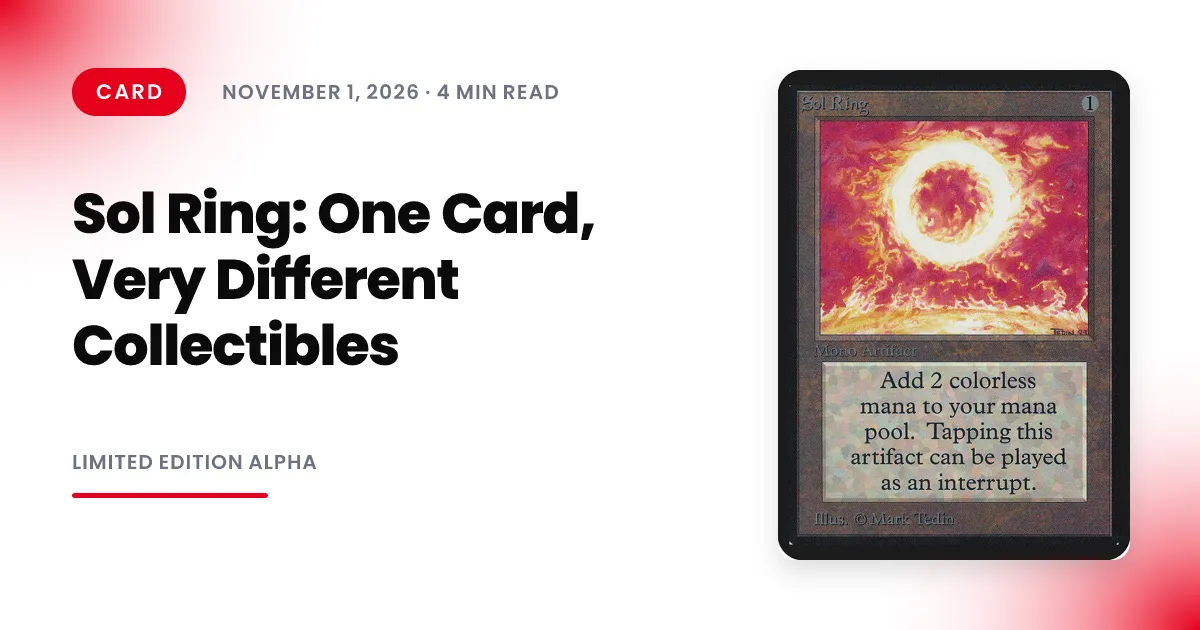
Older text boxes can make this look less clear. A printed numeral in the mana ability means colorless mana, not mana of any color. Wizards explains the change to the diamond symbol in A Solemn Oath, Part 1. Different wording does not give an old Sol Ring a different ability.
Commander Gives the Card a Continuing Role
Sol Ring remains legal in tabletop multiplayer Commander as of November 1, 2026. It is banned in Legacy and restricted in Vintage, where only one copy is allowed across the main deck and sideboard. These are separate format rules; consult Wizards’ current banned and restricted list before building a deck.
Its place in Commander has been a deliberate choice. When Mana Crypt was banned, the September 2024 announcement explicitly kept Sol Ring, citing its identity within the format. That explains the decision then. It is not a promise about future legality.
For a playing copy, choose the artwork and finish you enjoy at a price you accept. An expensive treatment does not accelerate your deck any faster.
Alpha Is a Different Collecting Target
The Alpha Sol Ring shown in the header belongs to Magic’s first edition. Its early frame, Mark Tedin illustration, and rounded corners are part of the object a collector is looking for.
A modern reprint supplies another playable Sol Ring. It does not supply another Alpha copy. That distinction lets an original printing retain a collecting purpose even when the card itself remains available in later products.
Identify the edition before comparing prices. Alpha and Beta both have black borders, so border color alone will not separate them. Check the corners and print details together, then examine condition. Wear, inked edges, trimming, and creases matter more than a seller’s broad claim that a card is “old.” Our printing identification guide explains the comparison.
The Lord of the Rings Adds Another Kind of Scarcity
The themed Sol Rings from The Lord of the Rings: Tales of Middle-earth are distinct from The One Ring card. Wizards’ collecting guide documents Elven, Dwarven, and Human versions, each with non-foil and serialized double rainbow foil printings.
For the Elven version, Wizards specifies 300 serialized copies and 3,000 non-foil copies. Those are production totals for those exact treatments, not counts of all Sol Rings or cards still available for sale. A non-foil Elven copy is not an unnumbered copy from the serialized run.
Check the exact treatment and the physical card. A visible serial number does not authenticate it.
Compare Copies That a Buyer Could Substitute
An ordinary reprint’s listing cannot price an Alpha copy. An asking price for a serialized foil cannot price the matching non-foil artwork either.
Before buying, record the set, collector number where present, language, finish, and condition. For a serialized card, record the serial number too. Compare completed sales for that version, and keep graded copies separate from raw ones. If there are too few comparable sales, a precise valuation is not supported.
For an early or premium copy, ask for current front, back, and edge photographs. Use several non-destructive checks from our counterfeit guide, with experienced physical review when uncertainty remains.
The useful question is what you want to own. A playing copy buys the effect. Alpha buys a particular piece of early Magic. A themed or serialized printing buys a particular treatment. Identify that target before choosing the listing.
 Download on the App Store
 Get it on Google Play