Gaea's Cradle: Why Is This Land So Expensive?
By Foilio Team
In this article
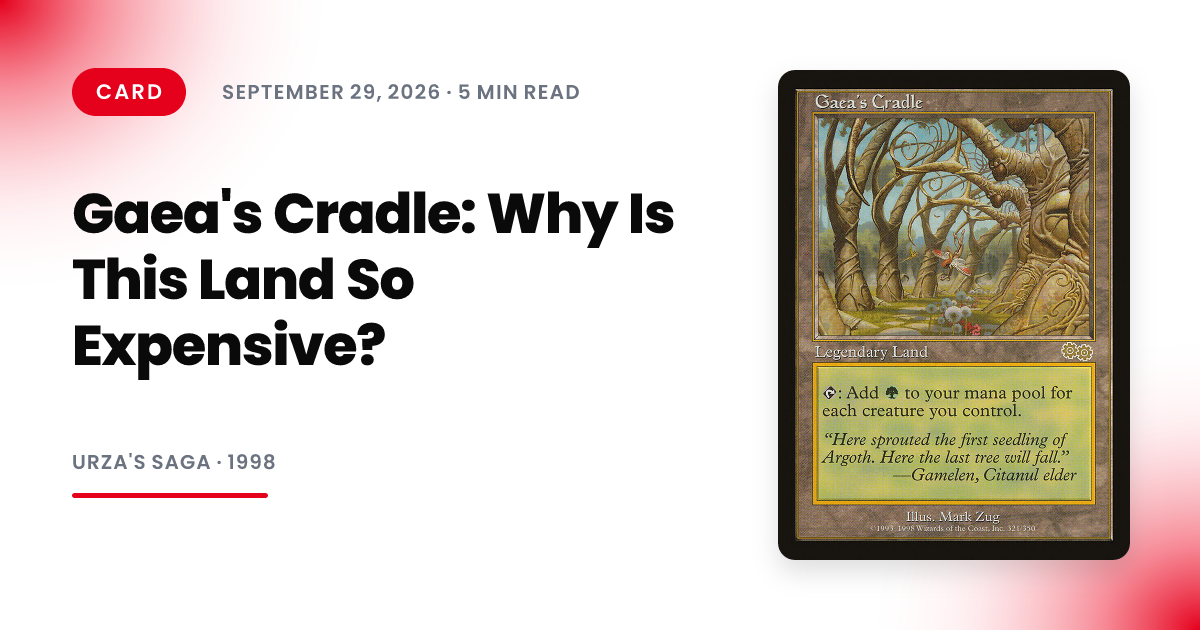
Gaea’s Cradle is expensive because unusually strong gameplay demand meets a supply that cannot grow through an ordinary tournament-legal reprint. It turns every creature you control into another green mana, appears in powerful creature decks, and belongs to Urza’s Saga, a set released in 1998.
That does not give every card named Gaea’s Cradle the same value. The original non-foil, the foil judge promotion, and non-tournament versions are different collectibles. Condition, language, authenticity, and the market where a copy is sold can widen the difference further.
What Gaea’s Cradle Does
Gaea’s Cradle is a legendary land. Its ability adds one green mana for each creature you control. The official Gatherer entry carries the current rules text.
With no creatures, it produces no mana. With one creature, it behaves much like a basic Forest. Once the battlefield holds several creatures or tokens, one land can produce the resources normally expected from several lands.
The effect compounds especially well in a creature deck. Small creatures can help build the board, the Cradle then pays for more creatures, and those new creatures increase its next activation. Wizards highlighted that rapid acceleration in an early list of notable nonbasic lands.
A Powerful Land Still Has Limits
Gaea’s Cradle does not create a strong battlefield by itself. A removal spell or board wipe can reduce its output to zero. It is also legendary, so you cannot keep two copies under your control at the same time under the normal rules.
Those limits affect deck building, but they do not impose an upfront mana cost. Playing a land usually consumes the land play for the turn rather than mana already available. That makes an effect which can produce four, six, or more mana difficult to reproduce at the same speed.
The card also rewards strategies that already want many creatures: Elves, token decks, and commanders that fill the battlefield. It is not equally useful in every green deck, and a copy should not be treated as an automatic upgrade without considering the deck and the playgroup.
Legal in Commander, but a Game Changer
As of September 29, 2026, Gaea’s Cradle is not on the Commander banned list. It is, however, on the Game Changers list used by the optional Commander Brackets system. Wizards explains that Gaea’s Cradle and Serra’s Sanctum can provide a large mana boost and rapidly accelerate a game in its Commander Brackets introduction.
That distinction matters. A Game Changer is not the same as a banned card. It is a signal that the card belongs in a stronger kind of game and should be part of the pregame conversation. The February 2026 Commander Brackets update kept the system in use, while the live banned and restricted list remains the place to check current legality.
For a buyer, legality answers only whether a card can be used. It does not guarantee that the card fits the expected power of a particular table.
The Reserved List Keeps Playable Supply Tight
Gaea’s Cradle appears on Wizards’ Reserved List. Under the official reprint policy, reserved cards will not be printed again in a functionally identical tournament-legal form. The policy applies to physical, tournament-legal cards and separately allows special-purpose versions not intended for regular play, such as oversized cards.
This means increasing demand cannot be answered by putting an ordinary Gaea’s Cradle into a new booster set. Existing playable copies have to satisfy players, collectors, and people completing older sets.
Reserved List status does not promise that a price will rise. Demand can weaken, formats and preferences can change, and different copies can sell for very different amounts. The policy explains a supply constraint, not an investment guarantee.
Which Gaea’s Cradle Do You Have?
The main physical versions should not be mixed when recording a collection or comparing prices:
| Version | What to check |
|---|---|
| Urza’s Saga #321 | Original old-frame, non-foil printing with the expansion symbol and a normal Magic back |
| Judge Gift Cards 1998 #3 | Foil promotional printing with a shooting-star foil mark |
| World Championship Decks 1999 | Gold-bordered card with a different back; not tournament legal |
| Legacy Championship prize card | Oversized display card; not a normal deck card |
Language matters within the original printing too. Do not value a copy from the name and front artwork alone. Check the border, set symbol, collector information, foil treatment, card back, size, and language before selecting a price.
Foilio can keep the exact printing and finish separate in your collection. Our guide to identifying an MTG card printing shows where to find the relevant clues.
Condition and Authenticity Come Before a Price
On a valuable older card, small physical differences can move the realistic sale price substantially. Inspect the front, back, edges, corners, surface, and centering. Look for creases, dents, ink, clouding, and attempted repairs, then use the condition scale of the marketplace you plan to use.
High value also creates an incentive for counterfeits and misleading listings. Compare a suspected card with a known genuine copy from the same printing, use several non-destructive observations, and seek qualified in-person help for a serious purchase. Our guides to card condition and spotting a fake Magic card provide a safer process.
Finally, compare completed sales or relevant market data for the exact version rather than the highest result attached to the name. A current listing is an asking price, not proof of a sale. Gaea’s Cradle is a useful example of why a card’s rules, printing, legality, and physical copy all need to be identified before its value can be understood.
 Download on the App Store
  Get it on Google Play