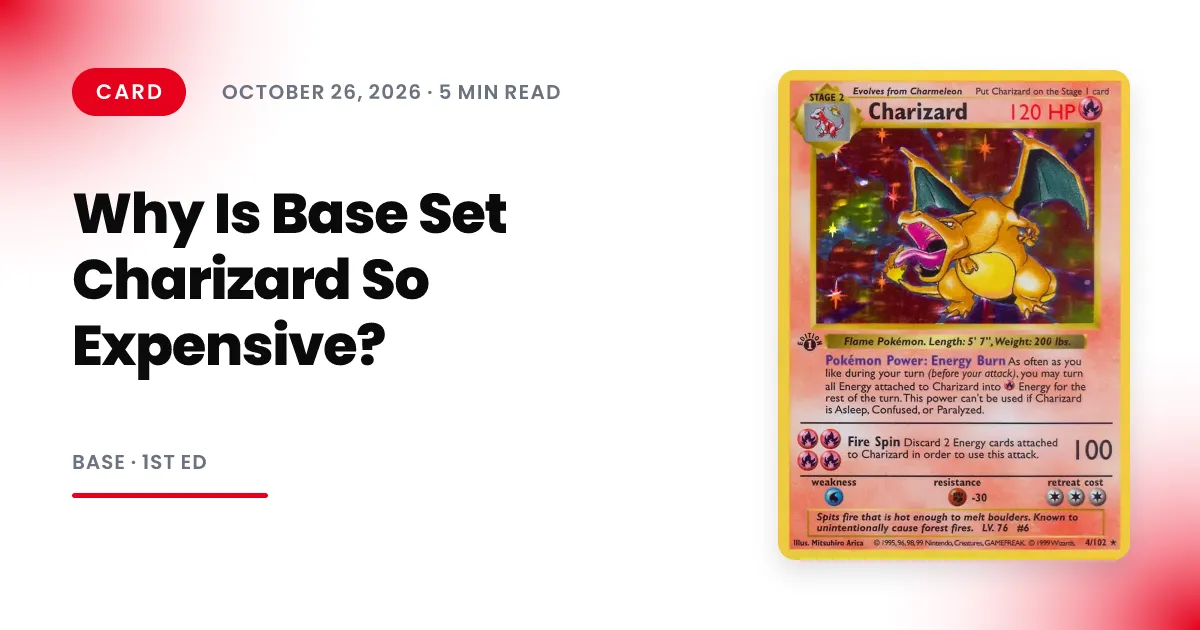
Why Is Base Set Charizard So Expensive?
By Foilio Team
In this article
Base Set Charizard is expensive because several kinds of demand meet a small supply of early English copies in strong condition. It is the best-known card from the 1999 Wizards of the Coast Base Set, carries Mitsuhiro Arita’s original illustration, and sits at the center of Pokémon collecting for players who grew up with the franchise and for collectors who treat top grades as trophies.
There is no single Charizard price. A Unlimited holo, a Shadowless copy, and a 1st Edition PSA 10 are different objects. Edition, condition, authenticity, and grading can separate two cards that share the same name and artwork by enormous amounts.
What the Card Actually Is
English Base Set Charizard is card number 4/102, a rare holographic Pokémon first released in the West on 9 January 1999 by Wizards of the Coast. The same illustration had already appeared in Japan’s Expansion Pack in 1996. The English card is the version most collectors outside Japan mean when they say “the Charizard.”
In the game it is a Stage 2 Fire Pokémon with a Fire Spin attack that discards Energy. That rules text is not what drives today’s headline prices. Demand comes from recognition, nostalgia, and the scarcity of clean early printings—not from competitive Standard play in 2026.
Many later sets reprint Charizard with new art, frames, and finishes. Those are separate collectibles. Cataloging or pricing a card requires the set, the printing, the language, and the physical condition—not only the Pokémon name.
Why This Charizard Became the Face of the Hobby
Charizard was already a star of the early video games and anime. Base Set put that popularity onto a holographic trading card during the English Pokémon boom. The combination stuck: for a large audience, “valuable Pokémon card” still means this Charizard first.
That cultural weight concentrates buyers on one printing family. New collectors enter the market looking for the card they remember. Investors and graded-card buyers chase the same early English holos. Public sales of high-grade 1st Edition copies then reinforce the card’s status without creating more original stock.
Fame alone does not set a fixed price. It explains why so many people care about distinguishing the early English versions from everything that came later.
1st Edition, Shadowless, and Unlimited Are Not the Same Card
English Base Set went through several print runs that collectors treat as distinct products. For Charizard, the practical distinctions are:
| Printing | How to recognize it |
|---|---|
| 1st Edition | Black “Edition 1” stamp left of the art window; no drop shadow on the art frame; thinner HP and attack text |
| Shadowless | No 1st Edition stamp; still no drop shadow; same thinner text as 1st Edition |
| Unlimited | Drop shadow on the right and bottom of the art window; bolder HP and attack text |
Every English Base Set 1st Edition Charizard is also shadowless in layout. Not every shadowless Charizard is 1st Edition. The stamp is the difference that usually moves the market the most.
Copyright lines and later Unlimited date variants can refine identification further, especially on cards without an art window. For Charizard, start with the stamp and the presence or absence of the drop shadow, then confirm the rest of the card against a known genuine copy of the same printing.
A distant photo of the artwork is not enough. Sellers sometimes label Unlimited holos as “1st Edition” or call any early layout “shadowless.” Record the exact printing before comparing prices.
Condition and Grading Move the Number
Early Base Set holos were played, bent, and stored without today’s care. Clean centering, sharp corners, intact edges, and a clean holo surface are scarce relative to how many people want them.
Professional grading adds an independent grade and a sealed holder. It does not make every slab equal: the grading company, the label, eye appeal, and population reports still matter. Compare completed sales for the same printing and similar grade. A Unlimited PSA 9 is not a reference price for a 1st Edition PSA 10.
Population at the top grade is small. PSA has graded only a little over a hundred Base Set 1st Edition Charizards as PSA 10. That limited gem-mint supply is one reason headline auction results sit far above raw or mid-grade copies.
Documented public sales show how far the top end can travel. A PSA 10 1st Edition Charizard brought $550,000 at Heritage Auctions in December 2025. In February 2026, a PSA 10 associated with Logan Paul’s box break sold for $954,800 at Goldin. Those figures describe specific graded copies at specific moments—not the value of “Charizard” in general.
Authenticity Comes Before Any Asking Price
Counterfeits and misleading listings follow famous cards. Treat marketplace titles, stock photos, and claims of “1st Edition” as hypotheses until the physical card supports them.
Compare several non-destructive features with a genuine card from the same printing: stamp, shadow, text weight, print quality, stock, and holographic pattern. Avoid destructive “tests.” For a major purchase, use a reputable seller, clear return terms, payment protection, and qualified in-person review when the amount justifies it.
Many later Charizard cards are genuine and collectible on their own terms. They are still not substitutes for an early English Base Set holo when the buyer wants that specific object.
What Collectors Should Take Away
Base Set Charizard is expensive where nostalgia, cultural recognition, constrained early English supply, and grade scarcity overlap. The useful habit is the same as with other iconic cards: identify the exact printing, verify the copy, assess condition, and only then compare relevant sales.
Foilio is built for collectors who need that level of catalog detail across a collection. Pokémon support is on the way; until then, the principle still holds—write down the version you actually own, not only the name on the top of the card.
 Download on the App Store
 Get it on Google Play