The One Ring: From the 001/001 Card to a Modern Ban
By Foilio Team
In this article
The One Ring managed to bring together two sides of Magic within eighteen months. A single copy numbered 001/001 became a collectible watched around the world. Meanwhile, regular printings became so prominent in tournament decks that Wizards banned the card in Modern.
The same name therefore describes objects with very different stories. The one-of-one card is not a useful price comparison for a copy opened in a regular booster, even though both use the same game rules.
What The One Ring Does
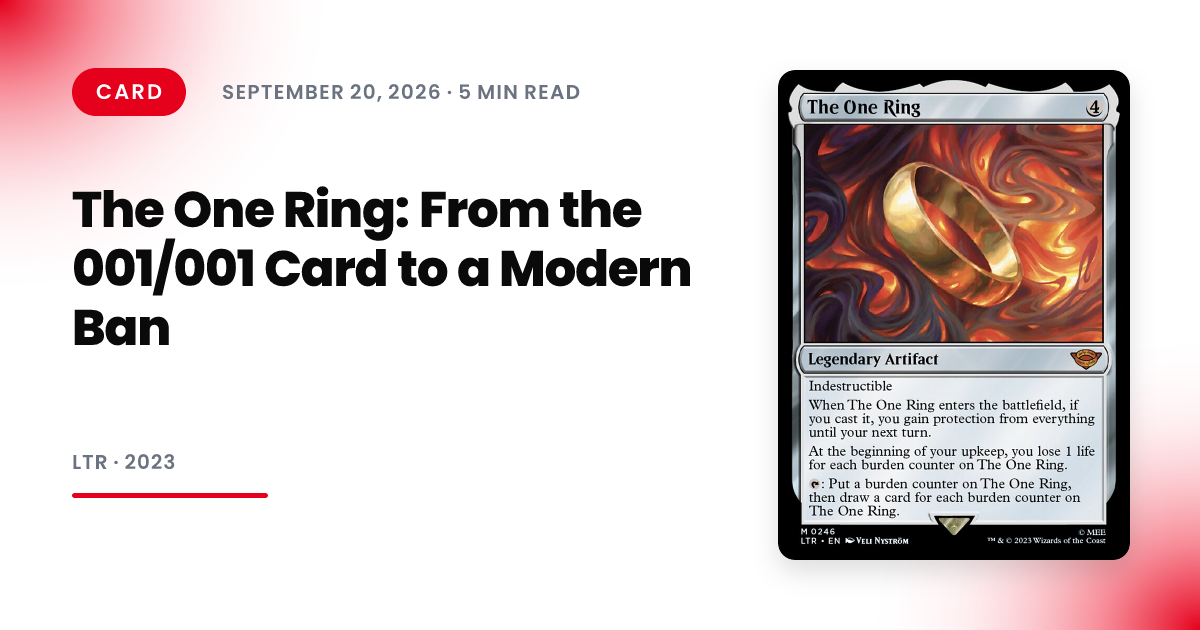
The One Ring is an indestructible legendary artifact that costs four mana. When you cast it, you gain protection from everything until your next turn. Tapping it puts a burden counter on it, then draws one card for each burden counter it has.
The advantage grows with each activation: you draw one card the first time, two the second, and three the third. The burden has a cost. At the beginning of your upkeep, you lose one life for each burden counter on the Ring.
The card first buys time and then exchanges life for an increasing number of cards in hand. It is also colorless, so including it does not require a particular color of mana. That combination of defense, card advantage, and easy inclusion in different decks later played a part in its ban.
The One Ring is not the same thing as the “the Ring tempts you” mechanic. That mechanic uses an emblem and a Ring-bearer, while this card is a separate artifact. The official set release notes provide the card’s full text and explain its interactions.
Why There Was Only One 001/001 Copy
The Lord of the Rings: Tales of Middle-earth was released in 2023. Wizards created a special The One Ring numbered 001/001 for the set: the only copy printed in this version. The Ring inscription in the Black Speech, written using Tengwar letterforms, replaced the rules text, and the card could only be found in an English-language Collector Booster.
The published booster breakdown gave an average chance of less than 0.00003% of opening it. This did not mean that a copy was guaranteed in every particular number of packs. Only one existed in the entire production run, and once it was found, no other pack could contain it. Wizards’ collector overview documents the card and its original distribution in detail.
The card was found in Canada, and in the summer of 2023 its finder, Brook Trafton, sold it to musician and Magic player Post Malone for $2 million. The Washington Post documented the discovery and private sale.
That amount belongs to one unique copy. It is not the price of “The One Ring” in general and cannot be transferred to another illustration, a foil, or a card with the same rules text.
One Name, Several Different Collectibles
Alongside the unique card, a regular card numbered 246 and several other treatments were released. They include an extended-art version, the Ring as part of a four-card Bundle scene, and later treatments from Special Edition Collector Boosters. Some differ in art, frame, or foil treatment, but they are not equally scarce.
| Version | What makes it different |
|---|---|
| Regular LTR #246 | Standard art and frame; foil and non-foil copies |
| Bundle promo | A borderless card from the four-card Mount Doom scene |
| Extended art and other special treatments | Different appearance and availability depending on the product |
| Serialized 001/001 | One copy with unique art, inscription, and serial number |
Writing only “The One Ring” is therefore not enough when recording a card or comparing prices. Check the set code, collector number, language, and finish. The same rules name does not mean the same collectible.
Why The One Ring Was Banned in Modern
Cards from the main LTR set were legal in Modern when released. The One Ring soon appeared in different archetypes because it protected its controller, refilled their hand, and required no colored mana.
Wizards was monitoring the card in August 2024 but did not ban it. At the time, the company said it did not support one dominant deck and helped several different strategies. Four months later, it had become part of the dominant Boros Energy deck, and Wizards concluded that including it involved too little opportunity cost.
The One Ring was therefore banned in Modern on December 16, 2024. The explanation cited its combination of self-preservation and card advantage, its use across many decks, and players’ fatigue with its presence. The full reasoning appears in the banned and restricted announcement.
A ban always applies to a specific format. It does not automatically ban the same card in every other format. Before building a deck, check the current Wizards list, rather than an old article or a store listing.
What the Ban Changed—and What It Did Not
Every printing of The One Ring has the same tournament legality, but buyers do not necessarily want them for the same reason. A Modern ban may matter more to a player buying a regular printing than to a collector seeking a particular illustration. For the 001/001 card, uniqueness and provenance are the main story, not its availability in one format.
This does not mean that one version must fall after a ban or that another will always retain its price. When comparing them, track the exact printing, the type of price, the date, and whether enough real sales exist. Our price-tracking guide explains why a listing, a completed sale, and an aggregate market price can differ.
Condition and authenticity also matter for an expensive copy. A card fresh from a pack is not guaranteed to receive the highest grade, and a destructive home test can cause damage. See our guides to card condition, checking a suspected counterfeit, and professional grading.
The One Ring is remarkable precisely because its story cannot be reduced to one price. For one copy, the 001/001 serial number was decisive. For thousands of others, the printing, finish, condition, and the formats where the card can be played all matter.
 Download on the App Store
  Get it on Google Play