Why Is Black Lotus So Expensive?
By Foilio Team
In this article
Black Lotus is expensive because several forms of demand meet a very limited supply. It belongs to Magic’s first releases, has one of the strongest effects ever printed, is instantly recognizable, and cannot receive an ordinary tournament-legal reprint under Wizards’ Reserved List policy.
That does not create one Black Lotus price. Edition, condition, authenticity, and grading can separate two copies by enormous amounts.
What Black Lotus Does
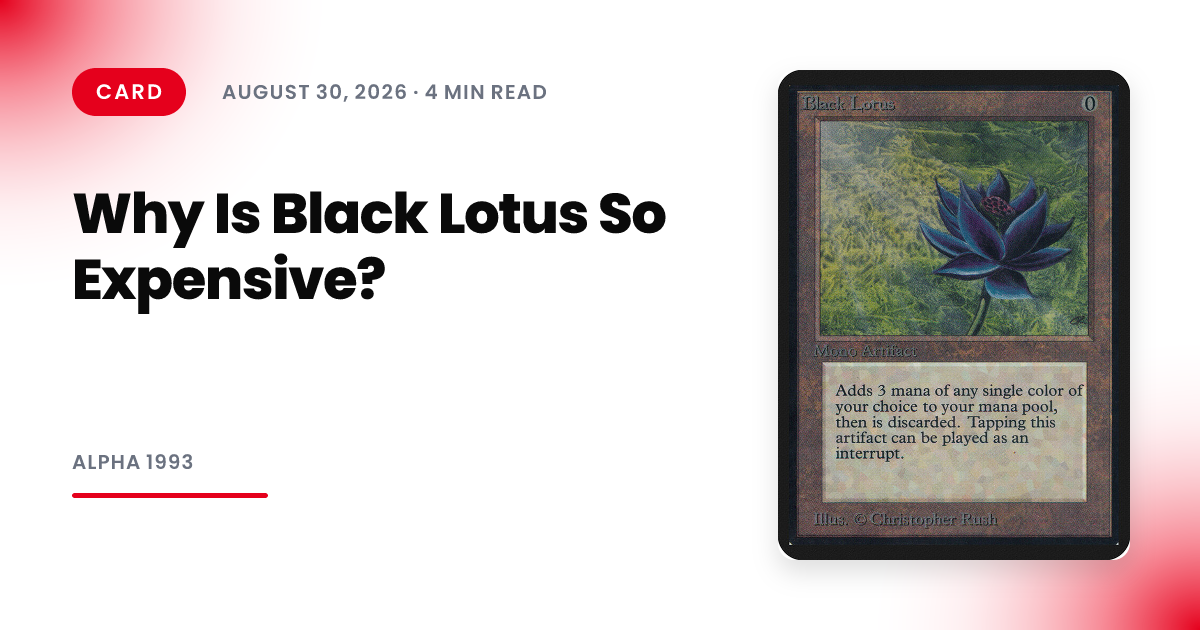
Black Lotus is a zero-mana artifact that can be sacrificed for three mana of one color. It converts one card into a burst of resources before a player has even played a land.
That efficiency places it among the Power Nine, the group of early cards famous for their strength and scarcity. Its gameplay reputation keeps the card meaningful to players even though most formats do not allow it.
Power alone cannot explain the price. Many strong cards have been printed in large quantities or reprinted later. Black Lotus combines power with historical position and constrained supply.
The Edition Changes the Object
Tournament-legal Black Lotus printings came from Limited Edition Alpha, Limited Edition Beta, and Unlimited Edition. Collector’s Edition and International Collector’s Edition also included the card, but with square corners and a gold-bordered back; they were not tournament-legal printings.
Alpha is recognized by features including more rounded corners and the layout of the first limited release. Beta looks similar but belongs to a different print run. Unlimited uses a white border. Collector’s Edition copies must not be cataloged as Alpha or Beta simply because the front artwork looks familiar.
The set, border, corners, card back, print detail, and physical dimensions all help identify the version. With a card this valuable, use several clues and expert review rather than a single photograph.
Scarcity Meets Cultural Importance
Early Magic had a far smaller print run than modern products, and some surviving cards were played without sleeves. Clean original copies are therefore a subset of an already limited supply.
Black Lotus also became a symbol beyond its rules text. It represents the beginning of the game, the Power Nine, high-profile collections, and headline auction sales. Buyers can want it as a game piece, historical artifact, status object, or completion target.
Those motivations compete for the same cards. Publicity can bring new bidders without creating new original copies.
The Reserved List Limits Reprints
Black Lotus appears on Wizards’ Reserved List. The policy prevents an ordinary reprint of the tournament-legal card while distinguishing certain special products that are not intended for regular sanctioned play.
Magic’s 30th Anniversary Edition illustrates that distinction. It included collectible versions with a different card back that were not tournament legal. Wizards’ official FAQ describes the product and its status.
These versions can have collector value, but they do not add more Alpha, Beta, or Unlimited copies to the market.
Condition and Grading Matter Enormously
Small differences become financially important when the base card is scarce and expensive. Centering, corners, edge wear, surface marks, print defects, creases, ink, and alterations can all affect demand.
Professional grading can add an independent opinion, a numerical grade, and a labeled holder. It does not make every copy comparable: buyers still care about the grading company, grade, eye appeal, provenance, and certificate. Compare completed sales for the same edition and similar grade, not the highest Black Lotus headline you can find.
Where It Can Be Played
As of September 20, 2026, Wizards lists Black Lotus as banned in Commander and Legacy and restricted in Vintage. Restricted means only one copy is allowed across a Vintage deck’s main deck and sideboard. Check the current format list before treating an old legality statement as current.
Much of today’s demand is therefore collectible rather than broad competitive demand. That makes provenance, presentation, and authenticity especially important.
Authenticity Comes Before Price
The price and fame of Black Lotus create a strong incentive for counterfeits and misleading listings. Confirm that the edition exists, compare with a known genuine card from the same printing, and examine the card as a whole. Avoid destructive “tests.”
For a serious purchase, use a reputable seller, clear return terms, appropriate payment protection, and qualified in-person review. Our guide to spotting a fake Magic card explains a safe comparison process.
Black Lotus is not expensive for one simple reason. It sits where game design, limited early production, reprint policy, condition rarity, and cultural recognition overlap. The practical lesson applies to less famous cards too: identify the exact version, verify the physical copy, and compare evidence from the market that actually trades that object.
 Download on the App Store
  Get it on Google Play